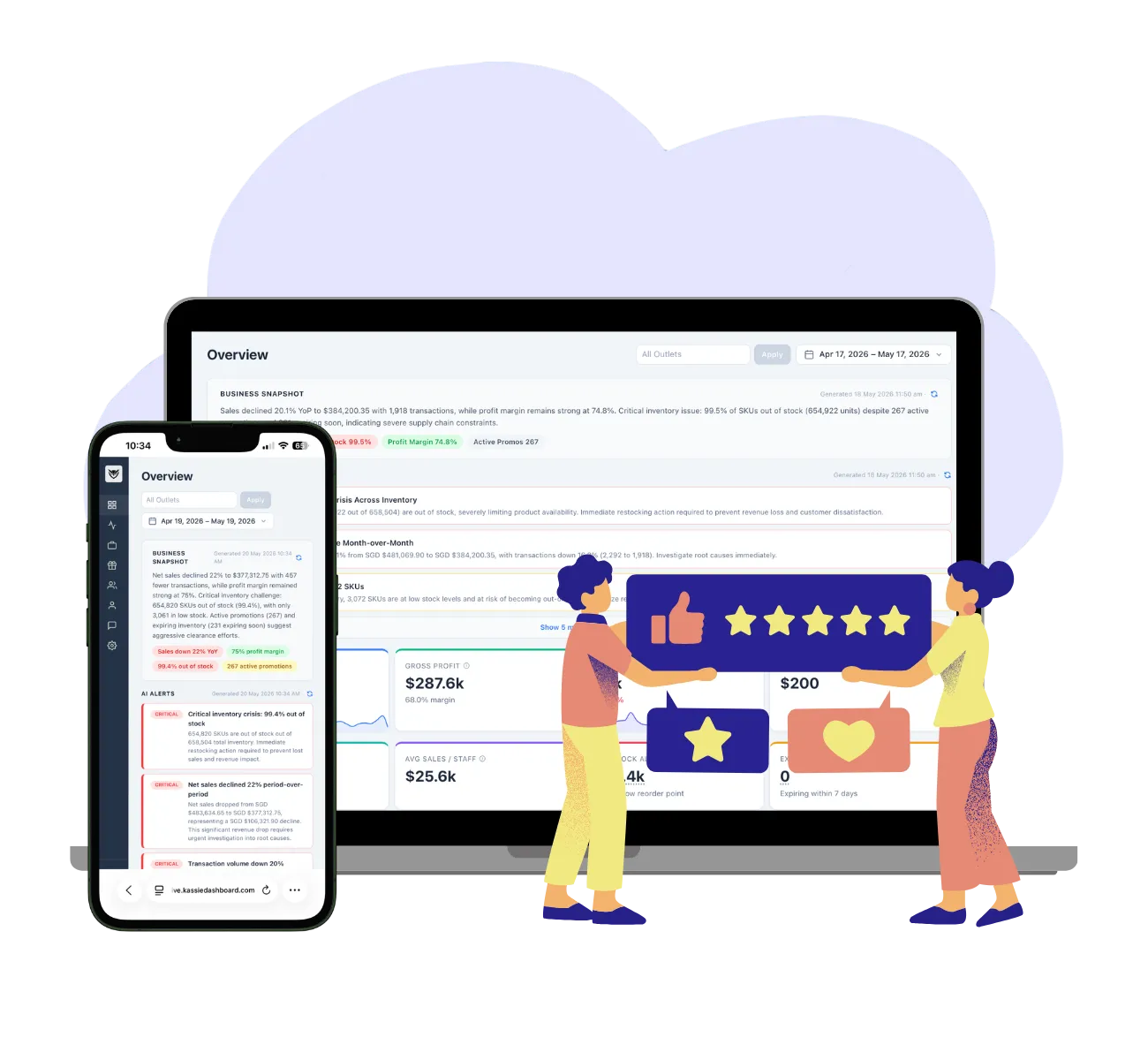
Built for Asian retail. Not adapted for it.
Every retail platform carries the assumptions of the market it was built for. Some assume online selling is primary and bolt physical retail on as an afterthought. Others assume European payment rails, Western consumer behaviour, and consulting-heavy implementation models. Some require a specific ERP before retail functionality even activates.
Asian retail operates on a fundamentally different set of requirements. Customers pay by GrabPay, PayNow, GCash, or Touch'n Go — and a checkout that does not accept these methods loses those customers. Mall management system integrations are mandatory for most tenants in Singapore and the Philippines. F&B is a major business category that most Western platforms ignore entirely. Multilingual staff interfaces, complex multi-location inventory, and enterprise ERP connectivity are not edge cases — they are table stakes.
Eleos was built in Singapore over 20 years for exactly this environment. Asian payments, F&B capability, mall integrations, multilingual support, and enterprise scalability are not add-ons or regional customisations — they are the platform's foundation. That is the difference between a platform built for your market and one trying to catch up to it.
Side by Side
The capabilities that matter — and where the gaps are.
This is not a feature checklist. These are the operational capabilities that determine whether a retail platform actually works for businesses operating in Asia.
| Capability | Eleos | E-commerce-first platforms | Other platforms |
|---|---|---|---|
| Asian payment methods (GrabPay, PayNow, GCash, Touch'n Go, FPX, Maya…) | All integrated natively | Add-on or aggregator required | Add-on, aggregator, or unavailable |
| F&B management suite (kitchen display, table service, split billing) | Food POS+, OctoWaiter, KDS — full suite | Not available | Not available or minimal |
| Physical retail architecture | Core product — built for in-store operations first | POS bolted onto online checkout | Retail-capable but carries regional or ERP assumptions |
| Mall management system integration | Supported natively | Not available | Custom project or not available |
| Enterprise ERP integration (SAP, Oracle, Dynamics, MYOB, Xero) | Middleware integration layer — connect to any ERP | Accounting tools only (QuickBooks, Xero) | Limited, or requires one specific ERP |
| No ERP prerequisite to go live | Yes — works independently or with any ERP | Yes — but limited retail depth | Some require Microsoft Dynamics before retail activates |
| Scales from SME to enterprise chain | Same platform, 1 to 500+ locations — no migration | Limited enterprise capability | Expensive upgrade or re-implementation required |
| Inventory: batch tracking, lot control, FIFO rotation | Full Stockpod capability | Basic online SKU management only | Basic or requires ERP |
| Marketplace integration (Lazada, Shopee, Amazon…) | Blue Ring — centralised inventory sync across all channels | Partial — primarily own marketplace ecosystem | Limited or separate channel management |
| E-commerce storefront | Hummingbird — connected to live POS inventory | Core strength | Weak or requires third-party |
| AI analytics (native) | Promptly — demand forecasting, anomaly detection, churn signals | Basic reporting or third-party apps | Not available natively |
| CRM & loyalty (native) | Jellybean — personalised marketing automation | Basic or app-dependent | Basic or third-party required |
| Local offices across Asia | SG, MY, PH, TW, CN, LK | No local offices in Asia | Remote support or regional sales office only |
| Implementation by own team | In-house delivery — 1,000+ deployments and 250+ enterprise projects across Asia | Self-service or third-party agencies | Third-party partners or consultants required |
| PSG grant eligible (Singapore SMEs) | Pre-approved — up to 50% co-funding | Not eligible | Not eligible |
| Time to first go-live | Weeks to months depending on scope | Days for basic; limited for complex retail | Often 6–24 months with consulting or ERP overhead |
| Multilingual (EN / 繁 / 简) | Supported | English-primary; limited CJK | English only or limited |
The numbers behind the platform.
Building retail technology inside Asia — not adapting Western products for Asian markets.
Delivered across Singapore, Philippines, Malaysia, Australia, and beyond.
Managed on a single platform — from one location to hundreds.
Across Asia — SG, MY, PH, TW, CN, LK. Local teams, local time zones, local expertise.
The brands that chose Eleos.
From global electronics and luxury retail to hospitality and F&B — these brands evaluated the alternatives and chose Eleos.






FAQ